AI Employee for Waitlist Management: A Practical Guide
Quick Answer
An AI employee for waitlist management is a role-trained AI worker that runs the repetitive, time-sensitive work of keeping a waitlist healthy and moving: it captures and confirms new signups, removes duplicates and stale entries, keeps everyone's status current, and — when a slot, spot or item becomes available — notifies the right people promptly according to the order and rules you set, handles their responses, and re-offers the slot if someone doesn't reply in time. It communicates clearly and fairly at every step, so people know where they stand, and it logs everything for a transparent, auditable record. The rules for who gets offered a scarce or high-value slot, and any exception to them, stay under your configuration and human oversight, so fairness and judgement remain in your control. Used well, it replaces a neglected spreadsheet and slow manual outreach with a fair, responsive, always-on waitlist that fills openings quickly and keeps people informed — without a person having to babysit the list.
Key Takeaways
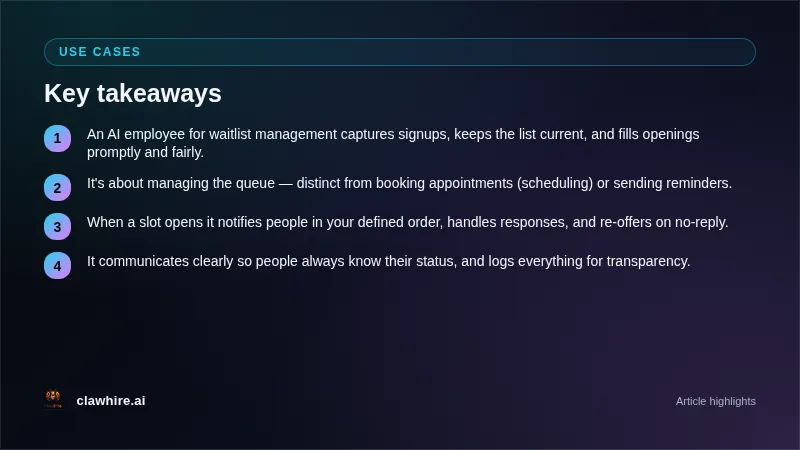
- An AI employee for waitlist management captures signups, keeps the list current, and fills openings promptly and fairly.
- It's about managing the queue — distinct from booking appointments (scheduling) or sending reminders.
- When a slot opens it notifies people in your defined order, handles responses, and re-offers on no-reply.
- It communicates clearly so people always know their status, and logs everything for transparency.
- The prioritisation rules and any exceptions stay under your configuration and human oversight for fairness.
- It removes duplicates and stale entries so the list stays accurate and trustworthy.
- Benefit: a fair, responsive, always-on waitlist; limitation: it runs your rules consistently, it doesn't set fairness policy for you.
What an AI employee for waitlist management does
An AI employee for waitlist management is a role-trained AI worker dedicated to keeping a waitlist accurate, fair and moving. Whenever demand outstrips immediate availability — a fully booked service, a limited product, a capped class or event, an oversubscribed appointment slot — a waitlist forms, and it needs constant tending: capturing new signups, confirming them, weeding out duplicates and people who are no longer interested, and, the moment something opens up, promptly offering it to the right person and handling their reply. The AI does all of this consistently and around the clock, so openings get filled fast and everyone is kept informed.
This matters because waitlists are usually managed badly — a spreadsheet someone forgets to update, sporadic manual outreach, openings that sit unfilled while eager people hear nothing. That is lost revenue for the business and a poor, opaque experience for the people waiting. An AI worker that tends the list continuously and communicates clearly fixes both. To place this in context, see what AI employees are, and note how this differs from an AI employee for appointment scheduling, which books appointments into open slots, and from appointment reminders, which reduce no-shows for already-booked appointments.
Waitlist management vs scheduling vs reminders
These three are easy to conflate but do different jobs, and matching the right one to your need matters. Appointment scheduling books people into available slots — it assumes availability exists and finds a time. Appointment reminders nudge people about appointments they already hold, to cut no-shows. Waitlist management handles the situation before a slot exists: it maintains an ordered queue of people wanting something that is not currently available, and springs into action to offer it fairly when it becomes available. This role's defining concern is the queue itself — keeping it current, fair and responsive — which is a distinct problem from booking a slot or reminding about one.
Why fairness and clarity are the whole point
A waitlist lives or dies on two things: being fair and being clear. People accept waiting far more readily when they trust the order is honest and they know where they stand. So the defining qualities of a good version of this role are that it applies your prioritisation rules consistently to everyone (no favouritism, no forgotten entries) and that it communicates status and offers promptly and transparently. The AI is well suited to both — tireless consistency and instant, clear communication — while you retain control of what the fairness rules actually are. That division keeps the experience trustworthy.
AI waitlist workflows: keeping the queue moving
The value of this role comes from running the whole waitlist lifecycle continuously rather than in neglected bursts, which is what keeps openings filled and people informed. Walking through the typical workflow shows how the AI carries the capture, maintenance, matching and communication while you keep control of the rules, turning a stale list into a living, responsive queue.
Capture, confirm and keep current
The workflow starts with signups: the AI captures new entries from your form, page or channel, confirms them so people know they are on the list, and records the details you need to prioritise and contact them. It then keeps the list current over time — deduplicating repeat signups, periodically checking whether people are still interested, and removing or flagging stale entries — so the queue reflects real, live demand rather than a bloated, inaccurate roster. This ongoing hygiene is exactly the tedious work that manual management neglects, and keeping it accurate is what makes every later step fair and reliable.
Match and notify when a slot opens
When availability appears — a cancellation frees an appointment, stock arrives, a place opens — the AI identifies who should be offered it according to the order and rules you have set, and notifies them promptly and clearly with what they need to know and how to respond. Speed matters here: the faster an opening is offered, the more likely it is filled and the better the experience, and an always-on AI can act the instant a slot appears rather than waiting for someone to notice. It applies your rules uniformly, so the same situation is always handled the same way.
Handle responses, expiry and re-offer
Once an offer goes out, the AI manages the response loop: it records acceptances and hands off to booking or fulfilment as configured, and if the person declines or does not respond within the window you set, it moves on and offers the slot to the next eligible person — so an opening is never lost to a single non-reply. It keeps everyone's status updated throughout and communicates clearly at each turn. This automated, fair re-offer loop is what keeps the queue genuinely moving and openings actually filled, instead of stalling on the first unresponsive contact.
What it handles — and what stays with a person
Being clear about the boundary keeps this role both efficient and fair, because while most waitlist work is routine, decisions about who gets scarce or valuable opportunities can carry fairness and business weight. The AI is strong at the continuous capture, maintenance, matching and communication; the policy behind prioritisation and any sensitive exceptions stay under your control. Drawing that line upfront is what lets you automate the toil while keeping fairness and judgement human.
Well-suited tasks
- Capturing and confirming new waitlist signups.
- Deduplicating and keeping entries current, removing stale ones.
- Maintaining each person's status and position transparently.
- Detecting openings and notifying the right people per your rules.
- Handling accept/decline/no-response and re-offering to the next person.
- Sending clear, fair, on-brand communications throughout.
- Reporting on list size, wait times, fill rates and drop-off.
Tasks that stay human or configurable
Some things should stay under your control or human oversight. That includes setting the prioritisation rules (how the order is decided — first-come, priority tiers, or other criteria), approving any exception that jumps the queue, deciding who gets genuinely scarce or high-value opportunities where judgement or fairness obligations apply, and handling disputes or sensitive cases. The AI applies the rules you define consistently and flags anything unusual; you own what the rules are and step in on the judgement calls. This keeps the fairness of the waitlist — which is ultimately a policy question — firmly in human hands while the AI handles the relentless execution.
Honest limitations
Be realistic about the boundaries. The AI applies the prioritisation rules you set — it does not decide for you what is fair, so a poorly-designed rule will be executed faithfully whether or not it is equitable; the fairness is your responsibility, and the AI's job is consistent, transparent application. It depends on accurate contact details and on people responding, so it manages non-response gracefully but cannot conjure a reply. It can report drop-off and wait times but cannot fix underlying scarcity — if demand vastly exceeds supply, a waitlist manages the queue, it does not eliminate the wait. And genuinely sensitive allocation decisions still warrant human judgement. None of these are reasons to avoid it; they simply mark where your policy and oversight matter alongside the automation.
Fairness, transparency and data care
Because a waitlist decides who gets access to something and holds people's contact details, this role should be run with fairness, transparency and sensible data care, and the AI supports all three by applying rules consistently, communicating openly and logging everything rather than by cutting any corner. The backbone is straightforward: a clear, consistently-applied ordering rule, honest communication about status, respectful handling of contact data, and a transparent record.
Consistent rules, honest communication, careful data
Three practices keep waitlist automation trustworthy. First, apply one clear ordering rule uniformly and be transparent about how the list works, so people trust the process — consistency and traceability echoed in accountable-AI guidance like the NIST AI Risk Management Framework. Second, communicate honestly: tell people they are on the list, roughly where they stand where appropriate, and what an offer means — clear, non-deceptive communication in the spirit of consumer-fairness guidance from bodies like the FTC. Third, treat contact data with care — collect only what you need, use it only for the waitlist, and respect privacy expectations and any applicable rules such as those summarised by the California Attorney General's CCPA guidance. Consistent, transparent, careful — exactly what an AI employee can sustain.
How to roll it out and measure it
The teams that get the most from waitlist automation set clear rules first and measure the outcomes that matter, rather than just switching it on, and the AI slots naturally into a staged rollout. A sensible sequence establishes the fairness rules and communications before widening scope, and pairing it with metrics tells you whether the list is genuinely healthier and openings are filling faster.
- Define the rules — decide the ordering (first-come, tiers, criteria) and the offer/expiry windows.
- Set the communications — confirmations, offers, status updates, on-brand and honest.
- Start with capture and hygiene — let the AI capture, confirm and keep the list current.
- Enable matching and re-offer — turn on opening-detection, notification and the re-offer loop.
- Review fairness and refine — check the log, confirm rules apply evenly, and tune windows and messaging.
For a structured rollout of the AI worker itself see our AI employee onboarding checklist and timing in the implementation timeline.
Metrics that matter
Decide upfront how you will judge success, focusing on a healthy, fair, moving list. Useful measures include fill rate (how many openings get filled from the list), time-to-fill (how fast an opening is claimed), average wait time and how it trends, list accuracy (duplicates and stale entries removed), response and acceptance rates to offers, and drop-off (people leaving the list) — plus a fairness check that the ordering rules are being applied evenly across everyone. Watching these tells you whether the waitlist is converting demand into filled slots and giving people a fair, clear experience. For related thinking see how to measure AI employee performance.
Frequently Asked Questions
- What exactly does an AI employee for waitlist management handle?
- It handles the full, continuous lifecycle of a waitlist so openings get filled fast and people stay informed, without anyone having to babysit a spreadsheet. It starts by capturing new signups from your form, page or channel and confirming them so people know they are on the list, recording the details you need to prioritise and contact them. It then keeps the list current over time — deduplicating repeat entries, periodically checking whether people are still interested, and removing or flagging stale ones — so the queue reflects real demand. When availability appears, whether from a cancellation, new stock, or a freed place, it identifies who should be offered it according to the order and rules you have configured and notifies them promptly and clearly. It manages the response loop: recording acceptances and handing off to your booking or fulfilment process, and if someone declines or does not reply within your set window, moving on to offer the slot to the next eligible person so it is never lost to one non-reply. Throughout it keeps everyone's status current, communicates fairly and transparently, and logs every step. What stays with you is the policy — the prioritisation rules and any exceptions — while the AI handles the relentless execution.
- How is waitlist management different from scheduling and reminders?
- They are three distinct jobs that are often confused, and matching the right one to your need matters. Appointment scheduling is about booking people into slots that are available now: it assumes availability exists and helps find and confirm a suitable time. Appointment reminders are about reducing no-shows for appointments people already hold: they nudge and confirm ahead of the booking. Waitlist management addresses the situation that exists before a slot is available at all: when demand exceeds current supply, it maintains an ordered queue of people who want something not presently available and springs into action to offer it fairly the moment it opens up. So the sequence in many businesses is that a waitlist manages the queue for a scarce resource, and when a place opens the accepted person flows into scheduling to book it, with reminders then reducing the chance they miss it. This role's defining concern is the queue itself — keeping it accurate, fair, and responsive, and filling openings promptly — which is a genuinely different problem from booking a known-available slot or reminding about a booked one. Recognising which of the three you actually need, or that you need all three working together, is the first step to solving the problem well.
- How does it decide who to offer an opening to?
- It applies the prioritisation rules that you define, consistently and transparently, rather than making up its own basis for fairness. You decide how the order works — it might be simple first-come-first-served, it might use priority tiers (for example existing customers, or membership levels), or it might use other criteria appropriate to your situation — and the AI then applies that ordering uniformly to everyone on the list. When an opening appears, it identifies the next eligible person or people according to those rules and offers the slot to them, and if they decline or do not respond in the window you set, it moves down the list to the next eligible person. Crucially, the AI does not invent or alter the fairness rules; setting them is your decision, as is approving any exception that would jump the queue and any genuinely sensitive allocation call. This division is deliberate: consistent, tireless, transparent application of the rules is exactly what an AI does well and what makes a waitlist feel fair, while deciding what the rules should be — and stepping in on judgement-heavy or sensitive cases — is a policy responsibility that stays firmly with you. The result is a queue that is both fairly ordered and demonstrably even-handed.
- What happens if someone doesn't respond to an offer?
- The AI manages non-response gracefully so that a single unresponsive person never causes an opening to be lost or the queue to stall, which is one of the biggest failings of manual waitlist handling. When it offers an opening, it does so with a clear response window that you configure — for example, a set number of hours to accept before the offer expires. If the person accepts, it records that and hands off to your booking or fulfilment process. If they explicitly decline, or if the window passes without a response, the AI treats the offer as lapsed and automatically moves on to offer the same opening to the next eligible person according to your rules, and so on down the list until it is filled. Throughout, it keeps statuses accurate and communicates clearly, so the person who missed the window understands what happened and, depending on your rules, may retain their place for future openings or move as configured. This automated re-offer loop is what keeps the queue genuinely moving and ensures openings actually get filled promptly, rather than sitting idle while someone waits in vain for a reply that never comes. It does depend on having accurate contact details and on people ultimately engaging, so the AI handles the mechanics reliably, but it cannot force a response — it simply ensures non-response never blocks the list.
- How does it keep the waitlist fair and transparent?
- Fairness and transparency come from three disciplines that an AI employee can sustain far more reliably than sporadic manual effort. First, it applies one clear ordering rule uniformly to everyone — no favouritism, no entries quietly forgotten, no depending on who happens to be looking at the list — so similar situations are always handled the same way. Second, it communicates honestly and promptly: confirming that people are on the list, keeping their status current, being clear where appropriate about roughly where they stand, and explaining what an offer means and how to respond, so nobody is left in the dark wondering whether they have been overlooked. Third, it keeps a transparent, auditable log of every action — every signup, offer, response and re-offer — so you can review and demonstrate that the rules were applied evenly and investigate any concern. Trust in a waitlist rests almost entirely on people believing the order is honest and knowing where they stand, and these practices deliver exactly that. It is worth stressing that the AI provides consistent, transparent application, but the fairness of the underlying rules is your responsibility to design; the AI will faithfully execute whatever ordering you set, so equitable outcomes come from combining well-designed rules with the AI's even-handed, well-documented execution.
- How does it handle people's contact details and privacy?
- A waitlist inherently involves collecting and using people's contact information to reach them when an opening arises, so responsible data care is part of doing this role well. The sound approach — which the AI supports and which you configure — is data minimisation: collect only the information you actually need to prioritise and contact people for the waitlist, and use it only for that purpose rather than repurposing it for unrelated marketing without appropriate consent. Contact details should be handled within your platform's security and access controls, retained only as long as needed, and removed when someone leaves the list or the list is no longer active, in line with privacy expectations and any regulations that apply to you, such as those summarised in the California Attorney General's CCPA guidance or, for relevant audiences, broader data-protection rules. Being transparent with people about what you collect and why, and honouring requests to be removed, both builds trust and aligns with good privacy practice. The AI helps by handling this consistently — collecting only configured fields, using them only for waitlist communication, keeping accurate records, and honouring removals — but the governing choices about what to collect, how long to keep it, and which regulations apply are yours to set. Verify the specifics against your own requirements and, where needed, your advisers.
- Does it work with our signup channels and booking systems?
- The intended model is that an AI employee works inside the channels and systems you connect rather than as an isolated tool, so for waitlist management that means capturing signups from the form, page or channel where people join your list, communicating with them through the channels you use (such as email), and handing off accepted offers to whatever comes next — your booking or scheduling flow, your fulfilment process, or wherever the person needs to go once they have claimed an opening. Exactly which channels and systems connect, and how deeply, depends on your specific stack and what each supports, so the honest answer is to confirm the connections for your particular setup rather than assume every tool works out of the box. A natural pattern is for the waitlist role to hand an accepted person straight into an appointment-scheduling flow to book the freed slot, so the two work together seamlessly. The sensible approach is to validate during a trial that the AI can reliably capture your signups, communicate in your channels, and hand off accepted offers correctly, then expand as you confirm it fits. Because the value depends on these connections working smoothly, it is worth confirming the specifics for your systems during a free trial or by talking to our team rather than relying on a generic integrations claim.
- How do we get started, and what results can we expect?
- Start by deciding the rules, because the AI will apply whatever you set: choose your ordering (first-come, priority tiers, or other criteria), your offer and expiry windows, and your communications (confirmations, offers, status updates), keeping them honest and on-brand. Then begin with capture and hygiene — let the AI take over collecting and confirming signups and keeping the list deduplicated and current — before enabling the matching and re-offer loop that detects openings, notifies the right people, and moves down the list on non-response. Review the log early to confirm the rules are applying evenly, and tune the windows and messaging based on what you see. In terms of results, the realistic and honest expectation is a waitlist that stays accurate instead of drifting into a stale spreadsheet, openings that get filled faster because they are offered the instant they appear rather than whenever someone remembers, a fairer and clearer experience for the people waiting because they are kept informed and treated consistently, and useful visibility into fill rates, wait times and drop-off. What you should not expect — and should be sceptical of any vendor promising — is that automation eliminates the wait itself or invented conversion percentages; a waitlist manages scarcity fairly and responsively, it does not create supply. The best way to gauge the real impact is to run the role on your actual list and watch fill rate and time-to-fill improve.
Sources
Related
- ClawHire AI employees
- what AI employees are
- AI employee for appointment scheduling
- appointment reminders
- customer support
- whether AI employees integrate with your tools
- AI employee onboarding checklist
- implementation timeline
- how to measure AI employee performance
- how to build an AI workforce
- ClawHire pricing
- start a free trial
- talk to our team