AI Employee for Refund Processing: A Practical Guide
Quick Answer
An AI employee for refund processing is a role-trained AI worker that handles the repetitive, policy-heavy work around customer refund requests: it intakes each request, gathers the order, payment and eligibility context, checks the request against your refund policy, communicates clearly with the customer, and prepares a recommended resolution — consistently and around the clock. Crucially, the step that actually moves money — issuing the refund — and any decision to grant an exception outside policy stay behind human approval, so the AI prepares and recommends while a person authorises the disbursement. It grounds every decision in your real order data and policy rather than guessing, flags edge cases for review, and logs everything for a clean audit trail. Used well, it turns a slow, inconsistent, back-and-forth process into a fast, uniform, well-documented one, cutting response times and errors while keeping the financial control and fairness that refunds demand firmly in human hands.
Key Takeaways
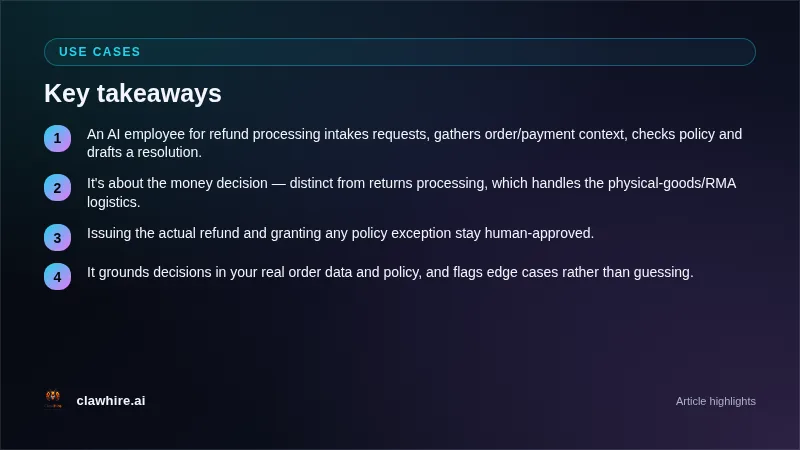
- An AI employee for refund processing intakes requests, gathers order/payment context, checks policy and drafts a resolution.
- It's about the money decision — distinct from returns processing, which handles the physical-goods/RMA logistics.
- Issuing the actual refund and granting any policy exception stay human-approved.
- It grounds decisions in your real order data and policy, and flags edge cases rather than guessing.
- It communicates clearly and consistently with customers and logs every step for audit.
- Benefit: faster, more consistent, well-documented refund handling; limitation: it prepares and recommends, people authorise the disbursement.
- Handled well, refunds can protect loyalty; the AI helps make them prompt, fair and policy-consistent.
What an AI employee for refund processing does
An AI employee for refund processing is a role-trained AI worker focused on the repetitive, policy-driven work that surrounds a customer's request to get their money back. When a refund request arrives, it intakes the request, pulls together the relevant context — the order, the payment, the timeline, the reason — checks that context against your written refund policy, communicates clearly with the customer, and prepares a recommended resolution for a person to authorise. The defining trait is that it does all the preparation and policy-checking consistently and quickly, while the act of actually issuing the money stays a human-approved decision.
This matters because refunds are simultaneously high-volume, emotionally charged, and financially consequential: customers want them handled fast and fairly, while the business needs them handled consistently and with proper control over money leaving the account. Doing this by hand is slow and uneven; doing it with an AI worker that applies your policy uniformly and prepares everything for sign-off makes it faster and fairer without loosening financial control. To place this in context, see what AI employees are, and note how this differs from an AI employee for returns processing, which handles the physical-goods and RMA logistics rather than the monetary refund decision.
Refund processing vs returns processing
It is worth drawing this distinction clearly, because the two are related but genuinely different jobs. Returns processing is about the goods: authorising a return, generating an RMA, tracking the item back, and inspecting it. Refund processing is about the money: validating the request against policy, deciding what (if anything) to refund, and issuing that disbursement. A return often triggers a refund, and the two frequently work together, but the refund role's defining concern is the monetary resolution and the financial control around it — which is why the human-approval boundary sits exactly where money moves. Recognising which part of the flow you are automating keeps the design and the controls right.
Why the money step stays human
The single most important design choice in this role is that the AI does not autonomously move money. Issuing a refund is an irreversible financial action, and granting an exception outside policy is a judgement call with cost and fairness implications, so both stay human-approved. The AI's job is to make that human decision fast and easy: assemble the full context, apply the policy, flag anything unusual, and present a clear recommendation ready to authorise. This keeps the speed and consistency benefits while preserving the financial control, segregation of duties and accountability that handling customers' money properly requires.
AI refund workflows: from request to resolution
The value of this role comes from running the full, repetitive refund workflow consistently rather than leaving it to whoever has time, which is where delays and inconsistency creep in. Walking through the typical steps shows how the AI carries the intake, context-gathering, policy-checking and communication while a person retains the authorising decision, turning a scattered back-and-forth into a clean, predictable pipeline.
Intake and context gathering
The workflow begins when a refund request arrives — by email, form, chat or help desk — and the AI captures it and immediately gathers the surrounding context: the order details, the payment record, the purchase date and any deadlines, the customer's history, and the stated reason for the request. Instead of an agent hunting across systems to piece this together, the AI assembles a complete, structured picture in one place. This is where much of the manual time in refunds is spent, so having it collected consistently and instantly both speeds up resolution and ensures every decision is made on the full facts rather than a partial view.
Policy validation and recommendation
With the context assembled, the AI checks the request against your written refund policy: is it within the refund window, does the reason qualify, is the amount correct, are there conditions attached? Based on that, it prepares a clear recommendation — approve in full, approve in part, decline with a reason, or escalate as an edge case — always grounded in the policy and the real data rather than guesswork. Straightforward, clearly-in-policy cases can be teed up for quick human approval, while anything ambiguous or outside policy is flagged for a person to judge. This is what makes refunds consistent: the same policy applied the same way every time.
Customer communication and human-approved issuance
Throughout, the AI keeps the customer informed with clear, empathetic, on-brand messages — acknowledging the request, explaining what happens next, and communicating the outcome — which is a big part of what makes a refund experience feel fair even when the answer is partial or no. When a refund is to be issued, a person authorises it; the actual disbursement is human-approved, not automatic. Once approved, the AI can confirm the outcome to the customer and log the completed resolution. The result is a process that feels fast and communicative to the customer while the money movement stays firmly under human control.
What it handles — and what stays with a person
Being explicit about the boundary is what makes this role both efficient and financially safe, because refunds involve money leaving the business and judgement about fairness. The AI is strong at the high-volume intake, context-gathering, policy-checking and communication; the money movement and the genuine judgement calls stay with people. Drawing that line clearly upfront is what lets you gain speed and consistency without ever ceding financial control.
Well-suited tasks
- Intaking refund requests from email, forms, chat or the help desk.
- Gathering order, payment, timeline and customer-history context.
- Checking each request against your written refund policy.
- Preparing a clear, grounded recommendation (approve / partial / decline / escalate).
- Drafting clear, empathetic customer communications at each step.
- Confirming outcomes and logging every step for a complete audit trail.
- Surfacing patterns (e.g. recurring refund reasons) for the team to act on.
Tasks that stay human or approval-gated
Several steps deliberately stay with a person or behind explicit approval. That includes issuing the actual refund (moving the money), granting any exception outside policy, deciding genuinely ambiguous or high-value cases, handling disputes, chargebacks or fraud signals, and changing the refund policy itself. The AI prepares, checks, recommends and communicates; people authorise the disbursement and make the judgement calls. This is not a limitation to apologise for — keeping money movement and fairness decisions under human control, with proper segregation of duties, is exactly what makes automating the surrounding work safe and trustworthy.
Honest limitations
Be realistic about the boundaries. The AI applies the policy you give it, so an unclear or inconsistent policy will produce unclear recommendations — refund automation rewards a well-defined policy. It can flag a suspicious or fraudulent-looking request but should not adjudicate fraud alone; those go to people and your fraud tools. It handles the routine well but escalates genuinely novel, sensitive or high-value cases rather than forcing them. And it improves speed, consistency and documentation, but it does not remove the need for human authorisation of the money or for good judgement on the hard cases. These are manageable with clear policy and sensible thresholds, and any vendor implying fully autonomous, unapproved refund payouts is describing a financial-control risk, not a feature.
Controls, fairness and compliance
Because refunds move money and touch consumer-protection rules, this role should sit inside sound financial controls and fair, compliant practice, and the AI helps by applying policy consistently and documenting everything rather than by loosening any control. The backbone is familiar: apply a clear policy uniformly, keep money movement human-approved with segregation of duties, treat customers fairly and honestly, and keep a complete audit trail.
Segregation of duties, audit trail and consumer fairness
Two principles keep refund automation safe and fair. First, financial control: the party (or system) that prepares a refund should not be the one that unilaterally pays it, so keeping issuance human-approved preserves segregation of duties, and logging every step gives you a complete, reviewable audit trail — principles reflected in internal-control guidance such as COSO and accountable-AI practice like the NIST AI Risk Management Framework. Second, consumer fairness: refunds are governed by consumer-protection expectations and your own stated terms, so honouring your published policy consistently, communicating honestly, and avoiding deceptive practices — in line with guidance from bodies like the FTC — protects both the customer and the business. Applying policy uniformly and documenting decisions is exactly what an AI employee does well.
How to roll it out and measure it
The teams that succeed introduce refund automation gradually and measure it honestly, rather than switching everything on at once, and the AI fits naturally into a staged rollout. A sensible sequence builds trust in the recommendations before widening scope, and pairing it with clear metrics tells you whether it is genuinely improving speed, consistency and customer experience.
- Codify the policy — make your refund policy explicit and unambiguous for the AI to apply.
- Start with recommendations — have the AI prepare resolutions for human approval on all cases first.
- Expand fast-track — let clearly-in-policy, low-value cases be teed up for quick approval as trust grows.
- Keep money human-approved — issuance and exceptions stay behind sign-off throughout.
- Review and refine — check the audit trail, tune thresholds, and improve the policy where patterns emerge.
For a structured rollout of the AI worker itself see our AI employee onboarding checklist and timing in the implementation timeline.
Metrics that matter
Decide upfront how you will judge success, focusing on outcomes rather than raw automation. Useful measures include refund resolution time (how quickly requests are handled), policy-consistency (are similar cases treated alike?), first-contact resolution and reduced back-and-forth, customer satisfaction with the refund experience even when the answer is no, the share of cases cleanly handled versus escalated, and — importantly — zero unapproved disbursements thanks to the human-approval gate. Watch refund reasons too: the AI surfacing why refunds happen can point to product or process fixes upstream. For related thinking see how to measure AI employee performance.
Frequently Asked Questions
- What exactly does an AI employee for refund processing handle?
- It handles the repetitive, policy-driven work that surrounds a refund request, end to end except for the money movement itself. When a request arrives — by email, form, chat or help desk — it intakes it and gathers the full context: the order, the payment record, the purchase date and any refund-window deadlines, the customer's history, and the stated reason. It then checks that context against your written refund policy — is it in the window, does the reason qualify, is the amount right, are there conditions — and prepares a clear, grounded recommendation: approve in full, approve in part, decline with a reason, or escalate as an edge case. Alongside this it communicates with the customer in clear, empathetic, on-brand language at each step, so the person feels informed and treated fairly. What it does not do is autonomously issue the money: a person authorises the actual disbursement, and any exception outside policy is a human decision. Finally, it confirms outcomes to the customer and logs every step for a complete audit trail. In short, it does the intake, context-gathering, policy-checking and communication consistently and fast, while people retain control of the money and the hard judgement calls.
- How is refund processing different from returns processing?
- They are related but genuinely distinct jobs, and it helps to be precise because the controls differ. Returns processing is about the physical goods: authorising a return request, generating a return merchandise authorisation (RMA), tracking the item back to the warehouse, and inspecting its condition on arrival — a logistics-and-inventory flow. Refund processing is about the money: validating the request against your refund policy, determining what should be refunded, and issuing that disbursement — a financial flow with consumer-fairness and financial-control implications. The two often connect: a customer returns an item (returns processing) and that triggers a refund (refund processing), and many businesses run both together. But the refund role's defining concern is the monetary resolution and the control around money leaving the business, which is exactly why the human-approval boundary in this role sits at the point where money moves. If your need is to manage the goods coming back, that is the returns role; if it is to handle the money going out fairly and under control, that is the refund role. Recognising which part of the flow you are automating keeps both the design and the financial controls appropriate.
- Will it move money or issue refunds without a human approving it?
- No, and this is the most important safety boundary of the role. Issuing a refund moves real money out of the business and is effectively irreversible, and granting an exception outside your stated policy is a judgement call with both cost and fairness implications — so both are deliberately kept as human-approved steps rather than autonomous actions. The AI does all of the surrounding work: it intakes the request, assembles the full order and payment context, checks it against your refund policy, prepares a clear recommendation, and drafts the customer communication. It then presents that recommendation, ready for a person to authorise, and only after a human approves does the disbursement happen. This design preserves the financial-control principle of segregation of duties — the system that prepares a refund is not the one that unilaterally pays it — along with accountability and a complete audit trail. The benefit you get is speed and consistency on the heavy, repetitive parts of refund handling, while the moment that actually spends money stays firmly under human control. Any vendor implying that an AI will autonomously pay out refunds with no approval is describing a financial-control risk, not a desirable feature.
- How does it make refund decisions consistent and fair?
- Consistency and fairness come from applying one clear policy the same way every time, grounded in real data, and that is precisely what an AI employee does well. Rather than different agents interpreting the refund policy differently, or the outcome depending on who happens to pick up the request or what kind of day they are having, the AI checks every request against the same written policy using the actual order, payment and timeline data — so similar cases get treated alike. It does not guess or invent: where the facts or policy are ambiguous, it flags the case for a human rather than improvising an answer. Fairness is also about communication and honesty, so the AI keeps the customer informed with clear, empathetic messages that explain the outcome and the reasoning, which makes even a partial or declined refund feel fair and respectful rather than arbitrary. And because every decision and message is logged, you can review the audit trail to confirm the policy is being applied evenly and adjust it where you spot inconsistency. The combination — uniform policy application, grounding in real data, escalation of ambiguity, honest communication, and a reviewable record — is what turns refunds from an inconsistent, sometimes contentious process into a fair and predictable one.
- What happens with fraud, disputes and chargebacks?
- These higher-risk situations are deliberately kept in human hands, with the AI in a supporting rather than deciding role. On potential fraud, the AI can help by flagging signals — a request pattern that looks suspicious, mismatched details, an unusual frequency of refunds from one account — and surfacing them for review, but it should not adjudicate fraud on its own; those cases go to your people and your dedicated fraud tools, because getting a fraud call wrong in either direction (paying a fraudster or falsely accusing a genuine customer) carries real cost and risk. Disputes — where a customer contests a decision — similarly benefit from human judgement and empathy, so the AI escalates them with the full context assembled so a person can resolve them well. Chargebacks, which are formal payment reversals initiated through the card networks, involve their own processes, evidence requirements and deadlines that sit outside a simple refund decision, so these too are handled by people, though the AI's organised records and audit trail can make responding to them faster and better-evidenced. The guiding principle is that the AI accelerates and supports the routine, well-defined refund work while contested, risky, or formally-regulated situations remain human-handled — which is exactly the right division for protecting both the business and the customer.
- Does a good refund policy matter for this to work well?
- Yes — enormously, and being honest about this helps set the deployment up for success. An AI employee for refund processing applies the policy you give it, so the clarity and consistency of that policy directly determine the quality of its recommendations. A well-defined policy — clear on the refund window, what reasons qualify, how partial refunds work, what conditions apply, and how edge cases should be treated — lets the AI apply it crisply and consistently, teeing up straightforward cases for quick approval and flagging genuine exceptions cleanly. A vague, contradictory or unwritten policy, by contrast, will produce vague or uncertain recommendations and more escalations, because the AI correctly refuses to guess where the policy is silent. The good news is that preparing to deploy this role is itself a useful forcing function: articulating your refund policy clearly enough for an AI to apply it tends to surface ambiguities and inconsistencies you can then fix, which improves fairness and consistency even for the cases humans handle. So rather than a prerequisite hurdle, think of policy-clarification as part of the value — and start by making the policy explicit, then let the AI apply it uniformly, with humans deciding the exceptions and authorising the money.
- Does it work with our order, payment and support systems?
- The intended model is that an AI employee works inside the systems you connect rather than as a separate silo, so it can read the order and payment context it needs from your commerce and payment systems and operate within your support channels — email, forms, chat or help desk — to communicate with customers and record outcomes. Exactly which systems connect, and how deeply, depends on your specific stack and what each system supports, so the honest answer is to confirm the connections for your particular setup rather than assume every tool works out of the box. Importantly, connecting to a payment system for context and for a human-approved issuance step is different from granting autonomous payout authority: the design keeps the actual money movement human-approved regardless of how it is technically issued. The sensible approach is to validate, during a trial, that the AI can reliably see the order and payment context it needs and communicate in your support channels, prove the recommendation quality on real requests with a human approving every disbursement, and expand fast-tracking of clearly-in-policy cases as trust builds. Confirm the specific integrations for your systems during a free trial or by talking to our team rather than relying on a generic claim.
- How do we get started, and what results can we expect?
- Start by making your refund policy explicit and unambiguous, since that is what the AI applies — this step alone often improves consistency. Then begin conservatively: have the AI intake requests, gather context, check policy and prepare recommendations for a human to approve on every case, so you can see the quality of its work before widening its scope. As you gain confidence, let clearly-in-policy, lower-value cases be teed up for quick approval to capture speed gains, while keeping issuance and any exceptions human-approved throughout. Measure honestly against outcomes rather than raw automation: resolution time, policy-consistency across similar cases, reduced back-and-forth, customer satisfaction with the refund experience even when the answer is no, and — as a hard control — zero unapproved disbursements. In terms of results, the realistic and honest expectation is faster, more consistent, better-documented refund handling with less manual hunting across systems and clearer customer communication, plus useful visibility into why refunds are happening so you can fix upstream causes. What you should not expect — and should be wary of any vendor promising — is fully hands-off payouts or invented percentage improvements; the value is real and operational, and it is best confirmed by trialling the role on a representative slice of your own refund requests.
Sources
Related
- ClawHire AI employees
- what AI employees are
- AI employee for returns processing
- order processing
- customer support
- whether AI employees make mistakes
- AI employee onboarding checklist
- implementation timeline
- how to measure AI employee performance
- whether AI employees are secure
- ClawHire pricing
- start a free trial
- talk to our team