Can AI Employees Handle Multiple Languages?
Quick Answer
Yes — AI employees can generally handle multiple languages, understanding what people write in one language and responding appropriately in the same or another, while applying your policies consistently across all of them. This lets a single AI worker serve a global audience around the clock, answering customers or gathering information in their own language without you staffing native speakers for every market. The important nuances are that quality can vary between languages — typically strongest in widely-used ones and less reliable for low-resource languages, regional dialects, or highly idiomatic and culturally specific content — and that sensitive, legal, regulated, or brand-critical wording should be human-reviewed rather than trusted to automatic handling. So the honest answer is a confident yes for everyday multilingual communication, paired with sensible guardrails: choose which languages you support, verify quality in each, keep a clear path to escalate to human speakers, and human-review anything where a mistranslation would carry real consequences. Configured that way, multilingual AI employees genuinely widen your reach while keeping accuracy and nuance under control.
Key Takeaways
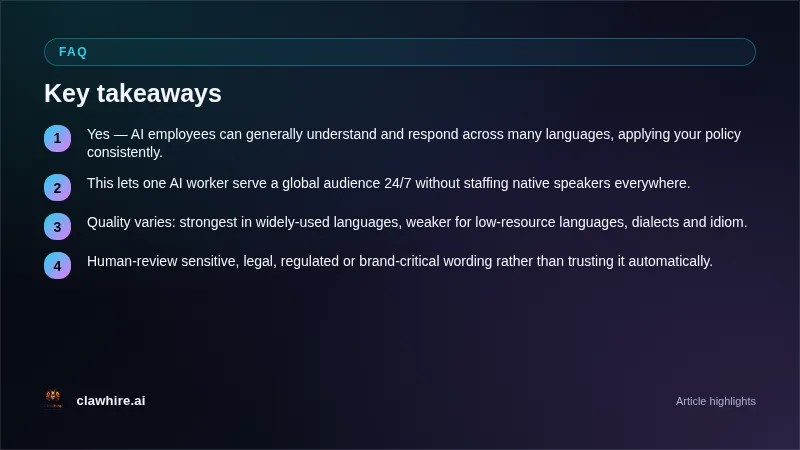
- Yes — AI employees can generally understand and respond across many languages, applying your policy consistently.
- This lets one AI worker serve a global audience 24/7 without staffing native speakers everywhere.
- Quality varies: strongest in widely-used languages, weaker for low-resource languages, dialects and idiom.
- Human-review sensitive, legal, regulated or brand-critical wording rather than trusting it automatically.
- Keep a clear path to escalate to human speakers for complex or nuanced cases.
- Configure which languages you support and verify quality in each before relying on it.
- Cultural nuance and tone matter — test how it reads to native speakers, don't assume.
Can AI employees handle multiple languages? The short answer
The question 'can AI employees handle multiple languages?' has a confident but nuanced answer: generally yes. Modern AI employees can understand messages written in one language and respond appropriately — in the same language or another — while applying your policies and knowledge consistently regardless of the language involved. That means a single AI worker can help a customer in Spanish, another in German, and another in Japanese, drawing on the same underlying rules and information, which is a genuine and valuable capability for any business serving more than one linguistic market.
The guardrails matter as much as the capability, though. Quality is not uniform across every language, cultural nuance can be lost, and some content — legal, regulated, or brand-critical wording — should not be left to automatic handling without human review. So the practical answer is: yes for everyday multilingual communication, configured thoughtfully with quality checks, human review where it counts, and a clear escalation path to human speakers. To ground this, see what AI employees are and, for the accuracy dimension generally, whether AI employees make mistakes.
What 'handling multiple languages' actually means
It helps to be precise about what the capability covers, because 'multilingual' can mean several things. It typically includes understanding incoming messages in various languages, responding in the language the person used (or another you choose), and doing so while applying the same policies, knowledge and tone guidelines you have configured — so the substance of the help is consistent even as the language changes. It can also include gathering information or conducting a survey in someone's own language. What it does not automatically guarantee is flawless, culturally-perfect output in every language, which is why quality verification and human review remain part of doing it well.
Consistency across languages is a real benefit
One underappreciated advantage is consistency: a multilingual AI employee applies the same rules, policies and information across every language it handles, so a customer asking a question in French gets the same substantive answer as one asking in English. With human teams, maintaining that consistency across languages and markets is genuinely hard — it requires training, translated materials, and coordination. An AI worker grounded in one set of policies naturally applies them uniformly, which can actually improve cross-market consistency, provided you have verified that the output quality holds up in each language you rely on.
How multilingual AI employees work in practice
Understanding roughly how the multilingual capability operates helps you deploy it sensibly and set the right expectations, because the mechanics explain both the strengths and the limits. In practice it comes down to understanding input across languages, generating appropriate output, and applying your consistent policy underneath — with your configuration shaping which languages and tone are in play.
Understand, respond, stay consistent
At a working level, a multilingual AI employee interprets the meaning of an incoming message regardless of its language, determines the appropriate response based on your configured policies and knowledge, and expresses that response in the relevant language. Because the underlying understanding and policy are shared, the same guidance is applied whether the exchange is in one language or another. This is why it can serve many languages without you maintaining a separate rulebook for each — the rules live once, and the language is the surface through which they are communicated. Verifying that this surface reads well in each language is the key quality step.
Configuring which languages and how
Sensible deployment starts with deciding which languages you actually want to support, based on where your customers or audience are, rather than assuming every possible language is equally reliable or needed. You can typically configure the languages in scope, the tone and style for each, and how the AI should behave when it encounters a language you have not prioritised — for example, responding in a default language or escalating. You also configure the review and escalation rules: where output should be human-checked and when to hand off to a human speaker. Thoughtful configuration is what turns a broad capability into a dependable service for your specific markets.
Where human speakers stay in the loop
Even a capable multilingual AI employee should have a clear path to human speakers for the cases that warrant it, and designing that path is part of doing this well. Complex, nuanced, sensitive, or high-stakes interactions — a delicate complaint, a legal or contractual matter, culturally subtle situations, or anything where getting the language exactly right really matters — benefit from a human who speaks the language natively. The AI handles the high-volume, everyday multilingual communication consistently and around the clock, while escalation ensures the cases that need genuine human fluency and cultural judgement reach someone equipped to handle them. That combination is what makes multilingual automation both wide-reaching and trustworthy.
Benefits and honest limitations
Multilingual capability brings real, tangible benefits, but using it well means being equally clear-eyed about where it is weaker, because overestimating uniform quality across every language is the main way multilingual automation disappoints. Seeing both sides lets you capture the reach while managing the risks with the right checks and human involvement.
The benefits
The advantages are significant for any business that serves, or wants to serve, more than one linguistic market. A single AI employee can support customers in many languages around the clock, so people get help in their own language at any hour without you hiring and staffing native speakers for every market and time zone — a reach that would otherwise be expensive and complex to build. It applies your policies consistently across languages, improving cross-market uniformity. It lowers the barrier to expanding into new markets, letting you offer multilingual support or gather multilingual feedback without a large upfront team. And it can make customers in underserved language markets feel genuinely served rather than forced into a second language. These are real, durable benefits, not hype.
The limitations to respect
The honest limitations matter just as much. Quality is not uniform: AI generally performs best in widely-used, well-resourced languages and less reliably in low-resource languages, regional dialects, or highly idiomatic and culturally specific communication, so you should verify quality in each language you rely on rather than assume it. Cultural nuance — tone, formality, local conventions, humour — can be missed or misjudged, which matters more in some cultures and contexts than others. And for sensitive, legal, regulated, or brand-critical wording, an automatic translation or response can carry real consequences if it is subtly wrong, so those should be human-reviewed. Recognising these limits is not a reason to avoid multilingual AI; it is precisely what lets you use it safely and effectively.
When to insist on human review
A useful rule of thumb is to match the level of human review to the consequences of getting the language wrong. Everyday informational exchanges — answering common questions, gathering routine feedback, general support — are well suited to being handled directly, with spot-checks to confirm quality. But anything where a subtle mistranslation would cause real harm deserves human review by a competent speaker: legal, contractual, medical, financial or regulatory wording; official notices; marketing and brand messaging where nuance and tone are the whole point; and sensitive personal communications. The AI can draft or handle the routine at scale, while a human verifies the high-stakes wording — a division that captures the efficiency without gambling on accuracy where it counts most.
What to evaluate before choosing an AI employee platform
If multilingual capability matters to you, evaluating a platform on it means looking past a marketing claim of 'supports 50+ languages' to how well it actually performs and how much control you have over quality and escalation in the specific languages you need. The points below help you judge real multilingual fitness rather than a headline number.
Multilingual evaluation checklist
- Real quality in your languages — test output in the specific languages you need, with native speakers, not just a language count.
- Consistent policy across languages — does it apply your rules and knowledge uniformly regardless of language?
- Configurable scope and tone — can you choose supported languages and set tone/formality per language?
- Human review controls — can you require review for sensitive, legal or brand-critical content?
- Escalation to human speakers — is there a clear path to hand nuanced cases to a person?
- Honesty about limits — does the vendor acknowledge quality varies, rather than claiming flawless everywhere?
ClawHire's AI employees are built around consistent, policy-grounded work with human-in-the-loop oversight and escalation. Confirm the specific languages and quality for your markets during a free trial or by talking to our team; pricing is usage-included from $149/mo — verify directly.
Frequently Asked Questions
- Can AI employees really handle multiple languages?
- Yes, generally they can, and it is one of the more genuinely useful capabilities for businesses that serve more than one linguistic market — but the honest, complete answer includes both the capability and its guardrails. On the capability side, a modern AI employee can understand messages written in a range of languages, respond appropriately in the language the person used or another you choose, and do so while applying the same policies, knowledge and tone you have configured, so the substance of the help stays consistent across languages. That means a single AI worker can assist a customer in Spanish, another in German and another in Japanese, drawing on one shared set of rules, and can do so around the clock without you staffing native speakers for every market and time zone. On the guardrail side, the quality is not identical across every language — it tends to be strongest in widely-used, well-resourced languages and less reliable in low-resource languages, regional dialects, or highly idiomatic and culturally specific communication — and cultural nuance can be missed, so sensitive, legal, regulated or brand-critical wording should be human-reviewed rather than trusted automatically. So the accurate answer is a confident yes for everyday multilingual communication, paired with sensible practices: pick the languages you support, verify quality in each, keep a clear path to escalate to human speakers, and human-review anything where a mistranslation would carry real consequences.
- How consistent is the quality across different languages?
- This is the most important nuance to understand, because the biggest mistake businesses make with multilingual AI is assuming uniform quality across every language when in reality it varies. AI language capability generally correlates with how well-resourced a language is — how much high-quality text exists in it — so performance is typically strongest in widely-used major languages and progressively less reliable in low-resource languages, less common regional dialects, and communication that is highly idiomatic, colloquial or culturally specific, where literal understanding can miss the real meaning. This does not mean lesser-resourced languages are unusable, but it does mean you should not take a vendor's headline 'supports 50+ languages' as a promise of equal quality in all of them. The right approach is to verify: for each language you actually plan to rely on, test the AI's output on realistic examples, ideally with native or fluent speakers who can judge not just correctness but tone, formality and naturalness. Where quality is strong, you can rely on it with routine spot-checks; where it is weaker, you can narrow the AI's role in that language (for example, handling simple queries while escalating more), add human review, or decide a human should handle that market for now. Treating quality as something to confirm per language, rather than assume across the board, is what separates successful multilingual deployments from disappointing ones, and it is a perfectly manageable step.
- How does a multilingual AI employee actually work?
- At a practical level, it works by separating the meaning of a message from the language it is expressed in. When a message comes in, the AI interprets its meaning regardless of the language it is written in; it then determines the appropriate response based on the policies, knowledge and guidelines you have configured; and finally it expresses that response in the relevant language — usually the one the person used, or another you have chosen. The crucial point is that the understanding and the policy underneath are shared across all languages, so the same substantive guidance is applied whether the conversation happens in one language or another. This is why a multilingual AI employee does not require you to maintain a separate rulebook, knowledge base or policy set for each language: the rules exist once, and each language is simply the surface through which they are understood and communicated. It is also why consistency across languages can actually be a strength — the same policy naturally applies everywhere, which is hard to achieve with separate human teams per market. Your configuration shapes the behaviour: which languages are in scope, the tone and formality for each, what happens when a non-prioritised language appears, and where human review or escalation should kick in. Understanding this mechanism helps set the right expectations — it explains both why the capability is broad and consistent, and why verifying that the language 'surface' reads well and naturally in each language remains an important quality step rather than something to take for granted.
- What are the risks or limitations of multilingual AI employees?
- There are a few real limitations worth respecting, and being clear about them is what lets you use multilingual AI safely rather than being caught out. The first is uneven quality across languages, already discussed: strong in well-resourced languages, weaker in low-resource ones, dialects and idiom, so quality must be verified per language rather than assumed. The second is cultural nuance: language is not just words but tone, formality, politeness conventions, humour and local expectations, and an AI can get the literal translation right while missing the cultural register — being too casual or too formal, or missing a connotation — which matters more in some cultures and contexts than others, and is easy to overlook if you only judge output in your own language. The third is the stakes of specific content: for legal, contractual, regulated, medical, financial or brand-critical wording, a subtle error or awkward phrasing can have real consequences — legal exposure, compliance problems, or brand damage — so this content warrants human review by a competent speaker rather than automatic handling. The fourth is that, as with any AI, it can occasionally misunderstand or respond imperfectly, and detecting that is harder in a language your team may not speak, which is another reason to have native-speaker review and clear escalation. None of these make multilingual AI a bad idea; they define how to deploy it well: verify quality per language, test how output reads to native speakers, keep human review for high-stakes wording, and maintain a clear escalation path to human speakers for the nuanced cases.
- When should a human handle the language instead of the AI?
- The guiding principle is to match the degree of human involvement to the consequences of getting the language wrong, so that the AI handles the high-volume routine while humans own the cases where accuracy and nuance really matter. On one end, everyday informational communication — answering common questions, providing general support, gathering routine feedback, sharing standard information — is well suited to being handled by the AI directly, in the customer's language, with periodic spot-checks to confirm quality is holding up. On the other end, several categories genuinely warrant human handling or at least human review by someone competent in the language: legal and contractual wording, where a mistranslation could change meaning or create liability; regulated content in areas like medical, financial or safety information, where accuracy is not optional; official notices and anything with compliance implications; marketing and brand messaging, where tone, nuance and cultural resonance are the entire point and a clumsy rendering undermines the brand; and sensitive or emotional personal communications, where empathy and cultural judgement matter. Between these ends sits a middle ground where the AI can draft or handle the interaction but a human reviews before anything consequential is finalised. Complex, nuanced or escalating situations should also route to a human who speaks the language natively. Designing these thresholds and escalation paths up front — deciding what the AI handles directly, what it drafts for review, and what goes straight to a person — is exactly how you get the reach and efficiency of multilingual automation without gambling on accuracy where the cost of being wrong is high.
- Can we control which languages the AI employee uses?
- Yes, and doing so deliberately is part of deploying multilingual capability well rather than just switching everything on. Sensible configuration starts with a business question rather than a technical one: which languages do your customers or audience actually use, and where do you genuinely want to offer service? Based on that, you can typically configure which languages are in scope, so the AI focuses on the ones that matter to you rather than attempting every possible language at uncertain quality. You can usually set the tone and style for each language — how formal or casual, matching your brand and the norms of that market. You can define how the AI should behave when it encounters a language you have not prioritised, such as responding in a default language, politely indicating the languages you support, or escalating to a person. And you configure the quality safeguards: which types of content or interactions require human review, and when to hand off to a human speaker. This configurability is what turns a broad, general capability into a dependable, well-scoped service for your specific markets. It also lets you expand deliberately — starting with the languages where you have verified strong quality and clear demand, then adding others as you confirm the AI performs well and you have the human review and escalation support in place. Rather than treating multilingual support as an all-or-nothing switch, treat it as a scoped, verifiable capability you configure and grow with intention.
- Is multilingual AI good enough for customer service in other languages?
- For a great deal of everyday customer service, yes — provided you verify quality in the specific languages you serve and keep sensible human review and escalation in place, which is the recurring theme with multilingual AI. The strong case for it is compelling: customers overwhelmingly prefer to be helped in their own language, and staffing native-speaking human agents for every language and every hour is expensive and often impractical, so a multilingual AI employee that can answer common questions, guide people, and gather information in a customer's own language around the clock genuinely improves the experience for audiences who would otherwise be underserved or forced into a second language. It also applies your support policies consistently across languages, which is hard to achieve with separate teams. The honest qualifications are the ones already covered: confirm the output quality in each language you rely on, ideally judged by native speakers for naturalness and tone as well as correctness; keep a clear path to escalate complex, sensitive or nuanced interactions to a human who speaks the language; and route or human-review anything high-stakes. Many businesses find the right model is the AI handling the large volume of routine multilingual queries directly while humans focus on the smaller number of complex or delicate ones — capturing most of the efficiency and reach while keeping quality where it matters. So 'good enough for customer service in other languages' is best answered per language and per use case: excellent for routine service in languages where you have verified quality, with human backup for the nuanced and high-stakes cases, and a more cautious or human-led approach in languages or situations where quality or nuance is harder to guarantee.
- Does ClawHire's AI support multiple languages, and how do we confirm it for our markets?
- ClawHire's AI employees are built around doing role-based work grounded in your policies and knowledge with human-in-the-loop oversight and escalation, which is the foundation that supports multilingual communication — understanding and responding across languages while applying your rules consistently, with people kept in the loop for oversight and the nuanced cases. Rather than leaning on a headline language count, which as discussed can overstate uniform quality, the reliable way to confirm suitability for your situation is to verify it directly for the specific languages and use cases you care about. During a free trial, or in conversation with our team, you can test how the AI understands and responds in the languages your customers actually use, judge the output for correctness, tone and naturalness — ideally with native or fluent speakers on your side — and confirm that the human review and escalation controls fit how you want high-stakes or sensitive multilingual content handled. That way you are basing the decision on observed quality in your real languages and scenarios rather than a generic claim. If multilingual capability is central to your needs, we would rather you confirm it concretely for your markets than take an unverified assurance, because that is how you end up with a deployment that genuinely serves your global audience well. Pricing is usage-included from $149/mo; verify current pricing directly, and reach out to discuss the specific languages and quality expectations for your markets.
Sources
Related
- ClawHire AI employees
- what AI employees are
- AI employee for customer support
- survey and feedback collection
- whether AI employees make mistakes
- what data an AI employee needs
- choosing an AI employee role
- how to measure AI employee performance
- how to build an AI workforce
- ClawHire pricing
- start a free trial
- talk to our team